
News
PAX and Wink enable enterprise merchants to design their own biometric enrollment and checkout

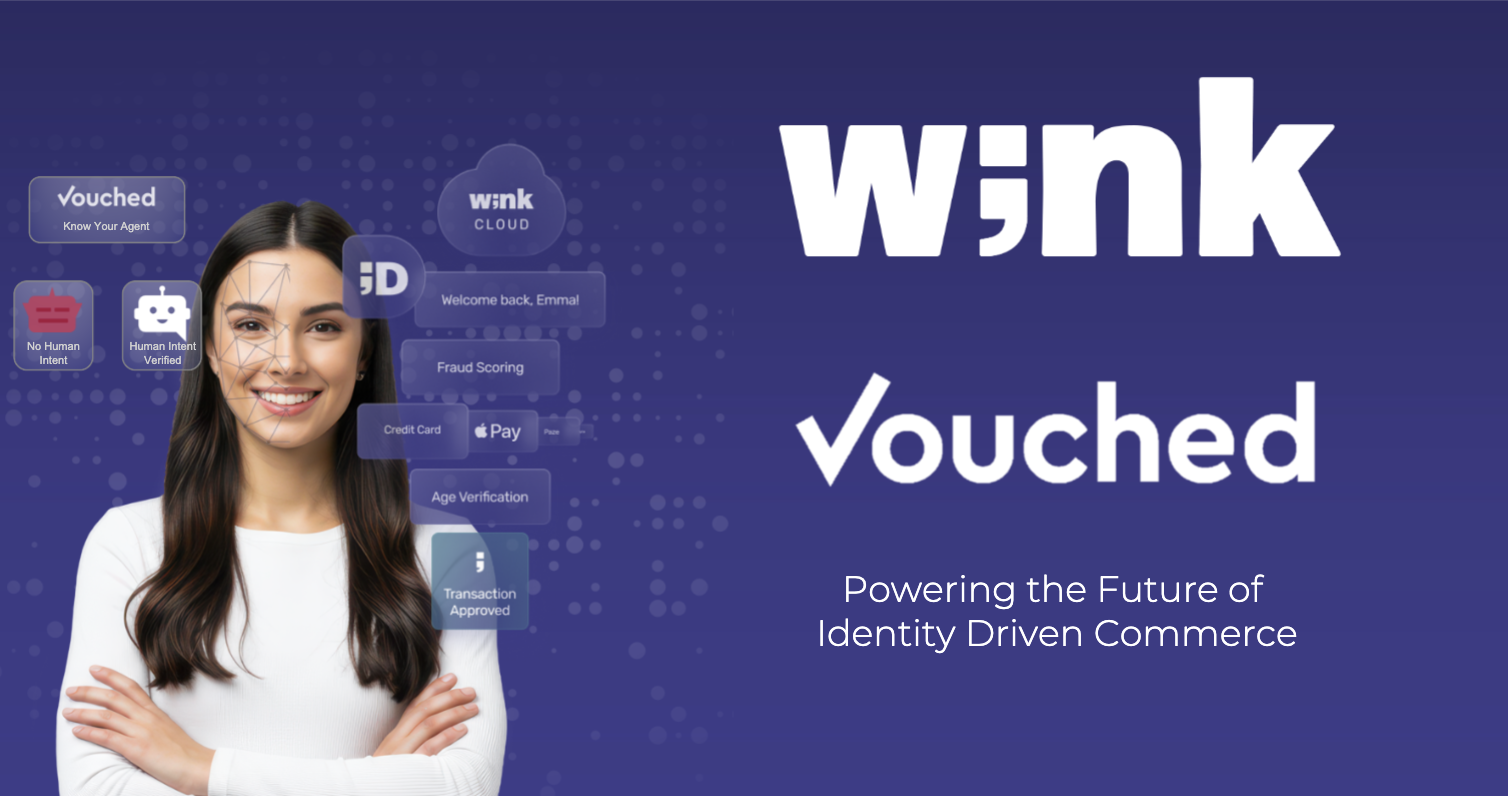
Wink and Vouched partner to bring biometric proof of personhood into the heart of agentic commerce — so every AI-driven action carries verified human intent.
AI agents are no longer theoretical. They're booking flights, making purchases, managing subscriptions, and executing financial transfers on behalf of real people — right now, today. The convenience is undeniable. So is the risk.
The problem isn't that agents act. The problem is that no one has solved how to prove, irrefutably, that a real human authorized the action — not just that a credential was present, not just that a token was valid, but that a living, consenting person said yes.
That gap is what Wink and Vouched are closing together.
Today's identity infrastructure was built for a world where humans authenticate themselves. A person opens an app, scans a face, enters a PIN, or taps a passkey. The system checks the credential. If it matches, access is granted.
Agentic commerce breaks that model entirely.
When an AI agent executes a task, there's no human at the keyboard. The agent acts autonomously — often across multiple systems, on devices the user doesn't own, hours or days after any human last touched the flow.
Traditional proof-of-ownership mechanisms — OTPs, passkeys, hardware tokens — were never designed for this scenario. They verify that a credential exists. They cannot verify that a human intended to use it.
A compromised agent, a hijacked session, or a prompt injection attack could execute thousands of transactions before a single fraud flag is raised. Enterprises deploying agents face accountability gaps they cannot currently close. And regulators are already asking: Who is liable when an agent acts without verifiable human authorization?
Wink is a biometric identity and agentic commerce platform. At its core, Wink creates a verified human profile — anchored to face, palm, and voice biometrics — and binds that profile to a portable set of credentials: payment tokens, loyalty accounts, government ID, membership status, and more.
Vouched is a leading identity verification platform and one of the industry's most active builders in the Know Your Agent (KYA) space. Their Agent Bouncer product — built on the MCP-I (modelcontextprotocol-identity) open specification — provides the infrastructure for capturing, verifying, and propagating agent authorization signals across agentic workflows.
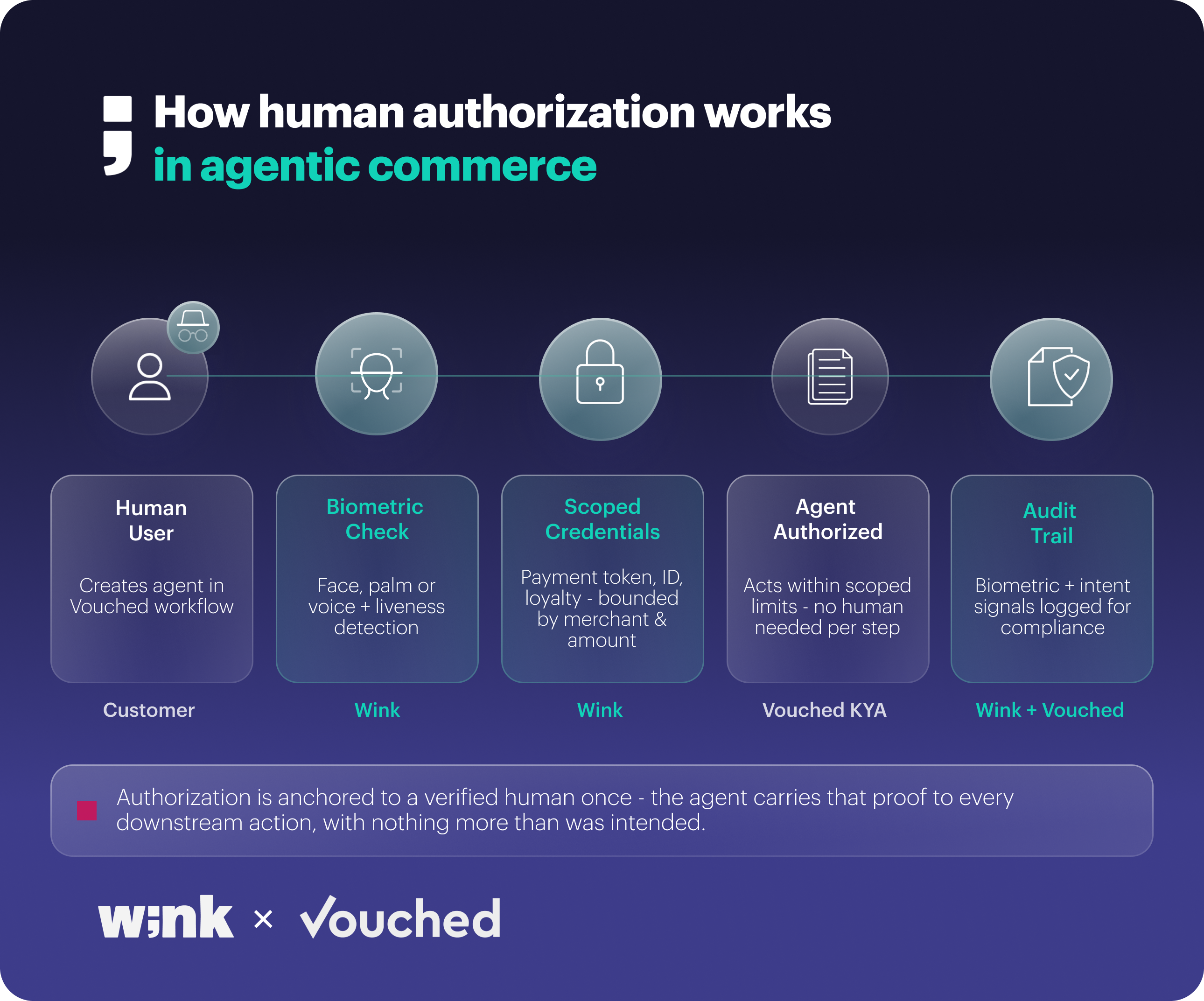
1. Human user creates agent in Vouched workflow
When a user creates or authorizes an AI agent inside Vouched's agent creation workflow, Wink's biometric authentication layer is invoked.
2. Biometric check with liveness detection
The user completes a real-time biometric check — face, palm, or voice — confirming their identity and their intent to authorize that specific agent. Wink's liveness detection ensures the biometric is from a live human, not a photo, deepfake, or replay attack.
3. Scoped credentials retrieved and bound
At the moment of authorization, the user's Wink profile is queried to retrieve any bound credentials relevant to the agent's scope — payment tokens (pre-authorized for a specific amount and/or merchant), loyalty accounts, government-verified identity, membership status, and more.
4. Agent authorized with verified human DNA
Those credentials are passed into the agent's authorization context, giving it the verified identity and payment capability it needs to act — without requiring the human to be present at every step.
5. Audit trail logged for compliance
The entire authorization event is logged with biometric, behavioral, and intent signals, creating a tamper-evident audit trail that can satisfy compliance, fraud, and regulatory requirements.
The result: An agent that carries verified human DNA from the moment it's created to every action it takes downstream.
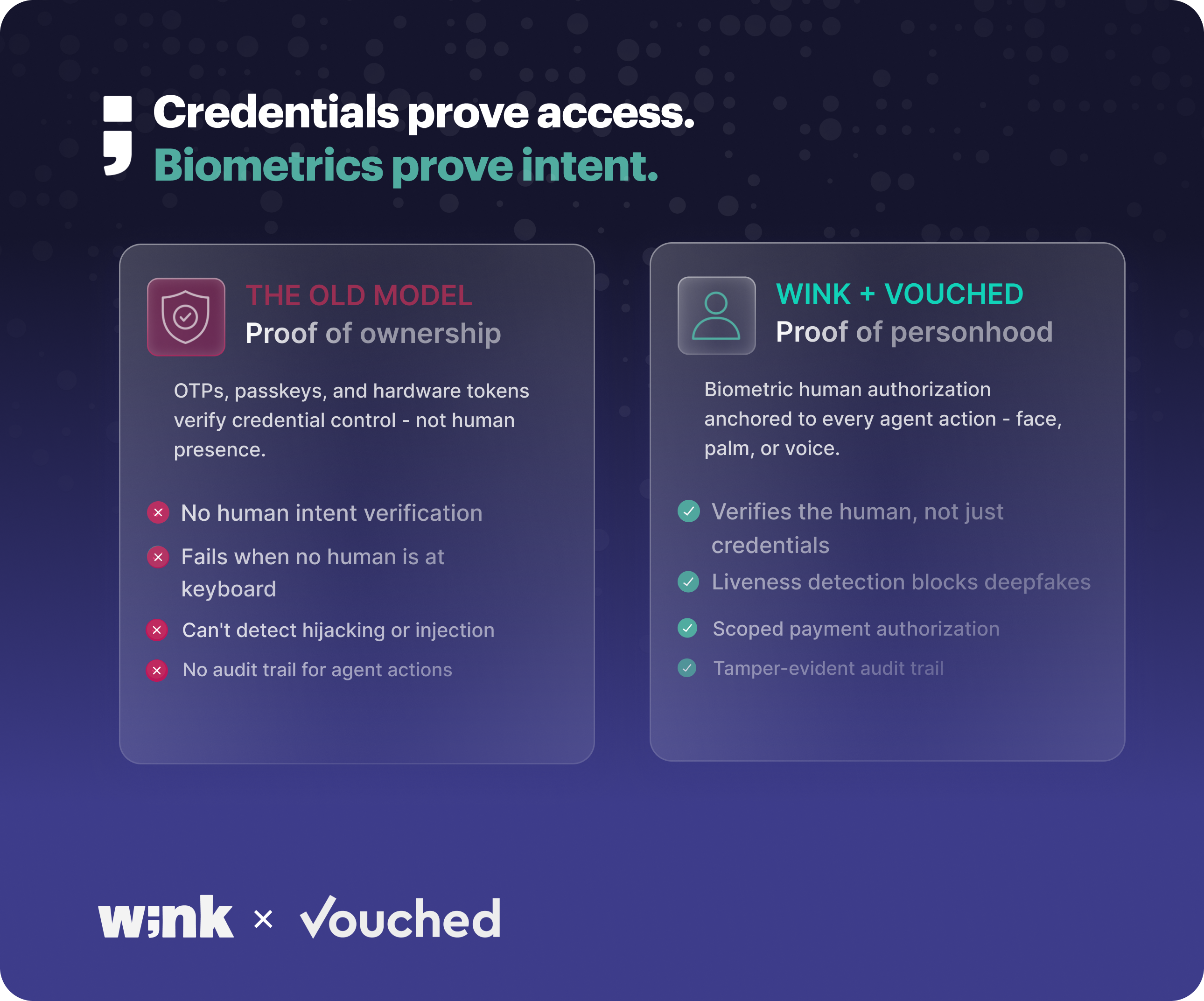
One of the most powerful — and underappreciated — elements of this integration is scoped payment authorization.
Today, when an agent is granted access to a payment method, it typically gets access to a broad set of capabilities — often more than the user intended, with limited controls on amount, merchant, or time window. This isn't just a UX problem. It's a fraud and liability problem.
This is the difference between giving an agent your credit card and giving an agent a signed check — one with your name, your amount, and your signature on it. The agent has what it needs. Nothing more.
Vouched has already established itself as a leader in KYA, with products spanning agent detection, agent verification, and the open MCP-I specification they donated to the Decentralized Identity Foundation.
Wink brings the biometric depth — multi-modal authentication, liveness detection, behavioral analysis, and a portable credential wallet — that transforms KYA from agent-level authorization into human-anchored authorization.
This matters because the regulatory and commercial expectations for agentic commerce are only going to intensify. Payment networks, financial institutions, and enterprise buyers are already asking: How can we prove a human authorized an agent-initiated transaction?
That question doesn't have a good answer today. This integration is the beginning of one.
Just as SSL became the invisible trust layer that made e-commerce possible, Wink and Vouched are building the trust layer that makes agentic commerce safe.
For developers building agents using Vouched's platform:
Wink's biometric verification becomes available as a first-class authorization mechanism. Adding human-anchored identity to an agent workflow no longer requires building bespoke biometric infrastructure.
For enterprises deploying agents to serve customers:
Whether in retail, financial services, healthcare, or travel — this integration provides the audit trail and authorization proof that compliance and legal teams need to sign off on agentic deployment at scale.
For end users:
The experience is frictionless. A single biometric check at agent creation time unlocks a verified identity and the relevant credentials the agent needs. The human authorizes once. The agent acts within those boundaries. Confidence is maintained throughout.
Wink and Vouched are launching this integration with a focus on agentic commerce use cases — shopping, loyalty, travel, and financial services — with plans to expand into healthcare, HR, and enterprise access management workflows.
Merchants and platforms interested in deploying trusted agentic experiences can reach out to either company directly to explore early access.
Wink is an open payments platform powered by biometrics and AI. Wink's three pillars — Identity, Commerce, and Intelligence — enable frictionless, secure experiences across in-store, e-commerce, and agentic workflows. Wink is recognized by Javelin Research as a Best in Class biometric authentication provider at the point of sale.
Vouched is a leading digital identity verification platform serving healthcare, financial services, automotive, and agentic AI use cases. Vouched is the creator of the Know Your Agent (KYA) framework and the MCP-I open specification for agentic identity, which it donated to the Decentralized Identity Foundation. Vouched is ranked No. 2 on the 2024 Deloitte Technology Fast 500 and is a recipient of the 2025 FinTech Breakthrough Award for Best Identity Verification Solution.