Blog
Rent or Own? How to Know When Your Gateway Should Be Yours
Meta just agreed to pay roughly $18 billion and hand the age-check problem up to the app stores. But the hard part of age verification was never the checking. It’s that almost every system built to do it learns far more about you than it needs to.
Meta agreed to settle claims from 52 state attorneys general that it built Instagram and Facebook to hook teenagers. The number will carry the headlines. The dependency underneath it is the more interesting story.
The behavioral commitments are real. A default two-hour daily cap for under-18 accounts. A midnight-to-6am blackout. Notifications silenced during school hours. Like counts hidden by default.
Every one of them is a rule about teenagers. Which means every one of them requires knowing, correctly, which accounts belong to teenagers.
Meta says it is “investing in even stronger technology” to catch users who misrepresent their age. In the same filing, it asks app stores to take that job on. Not deeper into its own product — up the stack, to Apple and Google.
Animated diagram. Four behavioral commitments stack onto a single base labelled “knowing which accounts are actually teenagers”. The base is then revealed as self-declared and never verified, and the entire stack tilts and slides apart as each commitment is stamped unenforceable. A counter falls from four of four commitments enforceable to zero of four.
This is not hypothetical. Four states — Texas, Utah, Louisiana, and California — have passed App Store Accountability laws requiring Apple and Google to verify age at the account level and pass a signal down to every app installed. Apple built the Declared Age Range API for it. Google built Play Age Signals.
The name is the tell. Apple has positioned the Declared Age Range API explicitly as an alternative to biometric age checks. It does not require a birth date. Parents set the range for a child account, and the user decides which range to share — a 14-year-old can declare 13 to 15, an adult can declare 16 or over. The range reaches a developer only if the user allows it, and that permission can be withdrawn later.
There is also a quieter limitation. The obligations attach to new accounts created after each state’s cutoff date. Existing adult and child accounts are not affected. Most teenagers already have an account.
So the statute says verify and the implementation says declare. That gap is not an oversight — Apple has a real data-minimization argument for it, and we will come back to why that argument deserves respect. But it changes what the signal actually means.
It is worth noting how unsettled the legal picture is on top of that. Texas’s version is the only one currently in force, and it got there through a procedural Supreme Court decision not to block it while the appeal continues. This is a shift underway, not a shift that is finished.
Mechanically, the model works like a venue wristband. You get checked once at the door. You get a band. From that point on, every bar inside the venue trusts the band instead of your face.
Animated diagram. A single check at the door issues a self-declared age band, which is then read in turn by three separate apps. Each app grants access on the strength of the band alone, and the count of documents checked downstream stays at zero.
The wristband model has two separate failures, and they are worth pulling apart, because fixing the first one does nothing about the second.
Failure one: the band is self-written. Nobody checked a document. The person wearing it supplied their own age range, or a parent supplied it for them. Apple would say that is the design rather than a shortcoming, and there is a real data-minimization argument behind it. But an age range someone assigned to themselves is a claim, not a verification.
Failure two: bands come off. This one survives even if you fix the first. Picture the strictest possible door — government ID, biometric match, the works. The band still ends up on a wrist, and wrists are transferable. An older sibling is the account holder. The phone gets handed to a 13-year-old. The session stays open, the signal stays green, and nothing asks again.
Animated diagram. A badge reading “verified 18 plus” stays tethered to a device while three different people take turns holding it: a 19-year-old account holder, a 13-year-old, and a 15-year-old friend. The badge remains in the verified state the entire time, and the re-check counter stays at zero.
This is neither hypothetical nor new. In 2014 the Federal Trade Commission brought actions against Apple, Google, and Amazon over exactly this pattern — children racking up charges on adults’ accounts, on adults’ devices, with adults’ payment methods attached. Apple refunded a minimum of $32.5 million. Google refunded a minimum of $19 million. Amazon fought it, lost, and ended up refunding up to $70 million.
The finding underneath all three was the same: an account being adult-verified tells you nothing about who is holding the device. The two companies now being asked to carry age verification for the entire app ecosystem have already been through this once.
The industry that handles it best is not one anyone cites as a technology leader. Alcohol delivery verifies the buyer at checkout and still checks ID at the door, because it concluded years ago that a check at purchase time says nothing about who receives the package. The check has to happen where the risk is, not where the signup was.
Making the door check stricter does not keep the wristband on the right wrist.
There is a loud version of the privacy objection to age verification and a serious one. The loud version says any age check is surveillance. The serious version is much harder to dismiss: I am not worried about being asked whether I am over 18. I am worried about what you keep after I answer.
That worry is well-earned. The standard implementation of an age gate asks you to photograph a government ID and upload it. In that single act you disclose your full legal name, your exact date of birth, your home address, your document number, your height — and a high-resolution photo of your face, pre-matched to all of it.
The site needed one piece of information. It now holds a complete identity dossier, on a server you will never see, under a retention policy you did not read.
Framed that way, the privacy concern is not anti-verification. It is a data minimization argument, and it is correct.
The problem with age verification has never been the question. It is the surplus.
Wink’s approach is built around the two problems above: the wristband that comes off, and the surplus that never goes away. Here is the mechanism, explicitly.
Once, at the start. A live face scan alongside a government-issued ID. Wink checks liveness, so a photograph of a photograph does not pass, confirms the document is real, and reads the date of birth. Biometric resolution runs in under 800 milliseconds.
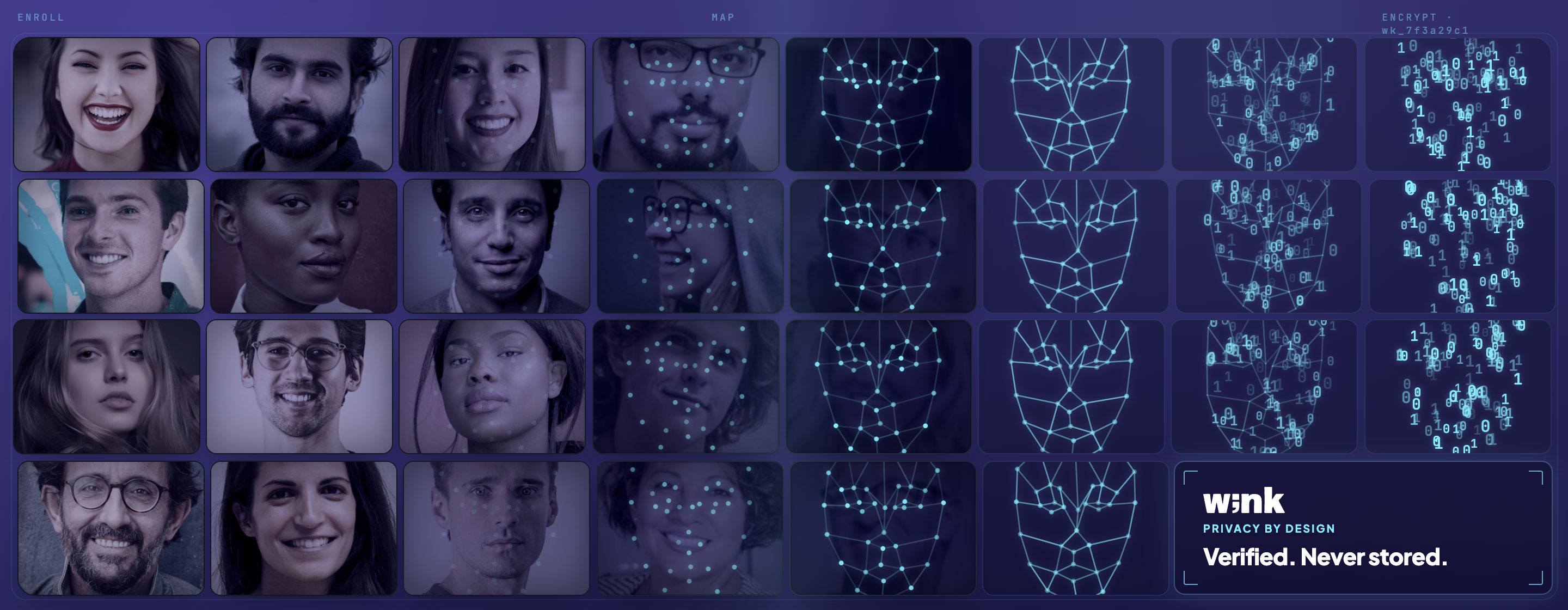
Immediately after. That verification collapses into a token — a one-way derivative tied to the face, not the document. The ID itself is discarded rather than stored. What remains can confirm a threshold was met. It cannot be run backwards into a name, a birthday, or a photograph.
Every time after that. The check is a live face match against the token. No document re-enters the flow. No inherited session gets trusted. The question is never “is this device cleared?” It is “is this the face on file?”
Animated diagram. Six fields from a government ID — full name, home address, date of birth, document number, height and eye color, and ID photograph — appear in a panel, then are struck through and faded out one by one until none remain. A single one-way token appears next to the emptied panel, followed by a single answer reading “21 plus”.
For an age check, the merchant never receives the ID, the photograph, or the biometric. They get a yes, a no, or an age bracket. That is all an age check ever needed, and all a merchant should want to be responsible for holding.
A signal confirms an account was checked. A token confirms a threshold was met. A face match confirms the person standing there is the one it was met by. Only the third one knows anything about who is actually in front of the screen.
Centralizing age verification means centralizing a target. That is fair to hold against anyone in this business, us included. So the question worth asking is not whether a provider could be breached. It is what a stolen record actually contains.
A provider that retains ID images and selfies hands an attacker a working identity kit: real documents, real faces, real birthdays, already matched to each other. A provider holding tokens hands them a column of one-way strings that confirm a threshold was met and nothing else.
Someone will reasonably push on this: does that first check not still see everything? It does. For a moment, your face and your document sit side by side and get matched. There is no honest way to verify a real ID without that happening. What matters is what is left over once it has. The document goes. The token stays. The token does not lead back.
We would rather describe it that way than call the whole process anonymous, because that first moment is not — and any vendor telling you otherwise is selling you something.
And notice who is missing from this picture entirely: the merchant.
The shop you bought from never held your document, your face, or your card number. It held a yes. So when the breach notifications go out — and they do go out — that merchant is not the one writing them. There is nothing in its system worth taking, because the sensitive part never travelled there to begin with.
This is not a courtesy to merchants. It is the reason they want it. A licence scan is an awkward thing to be holding — it has to be stored, secured, audited, insured, and eventually explained, and almost none of that work makes the business better at serving anyone. Most shops collecting ID at a checkout are not doing it because the document is useful to them. They are doing it because the law asked a question and uploading a licence was the only answer on offer.
A business that never held your address cannot lose it.
None of this means a business has to forget you.
There is a version of privacy that simply makes everything worse. No recognition, no saved preferences, start from scratch every visit, and a vague sense that you have been protected from something nobody quite names. That is not what this is.
A token is a stable thing. It is the same token on your fifth visit as it was on your first. A business can recognise it, attach a history to it, remember what you ordered, know that you are a regular and treat you like one. What it cannot do is turn that token back into your licence.
Think of a regular at a bar. The bartender knows your name, knows your drink, knows you were in last Thursday. They have never seen your passport. Recognition and identification are not the same act, and businesses ran on the first one for centuries without ever needing the second.
The industry’s mistake was assuming that to remember a customer you have to hold their identity. You have to hold a reference. Those are different things, and only one of them turns up in a breach notification.
A stolen document is permanent. A stolen token is noise.
Everything above describes verification. There is a second mode that asks for even less, and it deserves a proper explanation rather than a footnote — because it is a genuinely different tool, and the two get talked about as if they are the same thing.
Age estimation does not verify anyone. Computer vision reads facial features — bone structure, skin texture, proportion — and returns an estimated age range. No ID. No document check. No identity created, and nothing retained afterward. It answers “does this person look old enough?” rather than “is this person old enough?”
Wink offers both, because they solve different problems. Estimation is the lighter instrument: instant, frictionless, and private in the most literal sense, because there was never anything to keep. That makes it genuinely useful where a verified identity would be overkill or unwelcome.
But a guess degrades exactly where the stakes climb. Separating a 10-year-old from a 40-year-old is easy. Separating a 16-year-old from a 19-year-old is the actual regulatory question, and it is the hardest version of the problem.
Kiosks, vending, content walls, first-touch pre-screening. Anywhere a confident guess is enough and no identity needs to exist at all.
Alcohol, gambling, regulated purchase and delivery. Anywhere the ambiguous middle carries real legal liability. These route to a verified token.
Estimation answers what someone looks like. Verification answers who they are.
Checkout is where most of this conversation happens, and for good reason — it is where the liability is most visible, and it is where our own customers feel it first. But age is a condition on far more than purchases. It gates services, records, physical spaces, and entire categories of care.
Healthcare shows how different the requirement looks outside retail. Pharmacies apply age thresholds to specific over-the-counter medications. Telehealth platforms need to know whether a patient is a minor before a consultation begins, because the consent rules, the prescribing rules, and the record-access rules all change at that line. Patient portals have to handle the moment a pediatric record becomes an adult one, and a parent’s access has to end when it should.
Gaming and gambling operate under some of the strictest thresholds anywhere, enforced per session rather than per account. Financial services gate account opening and the transition out of custodial accounts. Venues gate entry to specific areas rather than the whole building. Unattended retail — smart fridges, vending, kiosks, delivery lockers — has no staff member to look at anything at all, which is exactly where an automated check has to be strongest.
Operationally these have almost nothing in common. What they share is the underlying question, and the fact that most of them currently answer it by asking someone to photograph a driver’s license.
Which raises the practical objection nobody has answered well. If every one of those places runs its own age check, a person ends up uploading the same government ID dozens of times, to dozens of organizations, each retaining its own copy under its own policy. Every upload is a new place the document can leak from. The privacy cost is not one careless vendor. It is the multiplication.
A token does not have that problem, because a token is not a document. One enrollment produces a verified age credential that works everywhere Wink is deployed — the dispensary counter, the delivery handoff, the online checkout, the kiosk, the venue door — without the ID re-entering the flow a single time after the first check.
What each place learns stays scoped to what it needs. A bar needs one thing: over 21, yes or no. A telehealth platform may need a different threshold entirely. Neither needs the document behind it, and neither receives it.
And portability without control would just be a faster way to leak. So the credential does not travel on its own. Each business that wants an answer has to be granted permission by the person, one at a time. Enrolling once does not quietly enroll you into every merchant on the network. It means that when a new one asks, answering takes a glance instead of a document upload — and the person can decline, or grant access and revoke it later, without touching any of the others.
More than age travels this way. An age token is the smallest thing Wink can hand over. One bit: old enough, or not.
But age is rarely the only thing a business needs. A shop that ships something needs somewhere to send it. A service calling to check it is really you needs a number to dial. And a returning customer would rather not type the same address for the fortieth time.
So the wallet holds more than a threshold. An address you entered yourself. A phone number. A payment method. Every piece of it follows the same rule: a business gets the fields you hand it, and nothing sitting beside them.
Think of the door staff at a venue versus the driver delivering to your house. The door needs one fact — are you old enough. The driver needs a different one — where do you live. Neither needs both. Neither should get both.
Same shop, two situations. Buying at the counter, they get a yes. Delivering to your door, they get a yes and an address. You choose which, business by business, and you can take it back later.
This is where Apple’s instinct deserves the credit we owed it earlier. Their age range is shared with a developer only if the user allows it, and the user can turn it back off. That part of the design is right, and anyone building in this space should copy it.
The difference is what sits behind the permission. In one case the user is granting access to a range they declared about themselves. In the other they are granting access to a threshold that was actually verified against a real document, and then reduced to something that cannot be turned back into one. Consent control and verification strength were never a trade-off. A system offering only one of them is half-built.
Uploading your ID to fifty organizations is not fifty age checks. It is fifty copies of your identity.
Age verification is not a standalone product bolted onto a checkout. It is one output of an identity layer that also handles login, fraud scoring, and payment authorization — which is why the same face scan that clears a 21+ threshold can also authorize the transaction that follows it.
That matters practically. An organization running age checks through one vendor, fraud through another, and payments through a third is maintaining three separate views of the same person, and reconciling them is where both cost and risk accumulate.
Face, palm, voice, and device recognition resolving in under 800 milliseconds, with real-time liveness detection. The same platform that verifies age also handles login, fraud scoring, returning-customer recognition, and biometric checkout — and because Wink vectorizes biometrics rather than storing images, there is no photo to breach.
The settlement will push a lot of platforms to buy age assurance quickly, and quick procurement is how organizations end up holding data they never wanted. These three questions separate a real privacy architecture from a compliance checkbox.
“We are secure” is not an answer. Ask specifically whether ID images and selfies persist after verification completes, and get the retention window in writing. A vendor that keeps documents has made a choice, not hit a technical constraint.
If the response payload includes a date of birth, a name, or an image, the merchant has just inherited liability it did not need. The answer should be a boolean or an age bracket — nothing that has to be defended in a breach notification.
This is the wristband question. Ask whether the verification is re-confirmed against the person at the point of action, or whether a flag set at signup gets trusted indefinitely. The difference determines whether shared devices are a gap or a non-issue.
A reusable credential is only an improvement if the person decides where it gets used. Ask whether permission is granted per business and revocable per business, or whether one enrollment quietly opens the door to everyone on the network. Portability without granular consent is not privacy. It is a faster distribution channel.
An age check should happen as often as the moment calls for it — at signup, at checkout, at the counter, at the door — without each additional check adding to what is at risk.
That is an architecture problem, and it has an architectural answer. Verify against the real document once. Reduce it to something one-way. Make the identity underneath unsurfaceable from that point on.
Not withheld. Not protected by policy. Unsurfaceable — because what would be surfaced no longer exists in a form that can be handed over, leaked, or subpoenaed.
The settlement pushes the industry toward checking age more often. The better version of that future is one where checking more often costs the person being checked nothing at all.
Wink Age Verification — online, in-store, kiosk, and at the door.